
A stock formula is a ready-made template a manufacturer sells to any brand — low cost, fast to market, but nutritionally identical across every customer who buys it. As a custom formulation and private label manufacturer, we (JBK) work with brands to adjust active ingredient levels, dosage form, and stability profile around their specific needs, backed by GMP, ISO 22000, HACCP, FDA, and HALAL certification, along with third-party testing. This nutrition comparison breaks down where custom and stock formulas actually diverge — on nutrient precision, raw material control, dosage form performance, compliance backing, and long-term cost — so brand owners can judge which path fits where their business stands today.
Why “Standard Formulas” Don’t Cut It Anymore
The supplement industry is expanding fast. According to Fortune Business Insights, the global dietary supplements market was valued at $100.92 billion in 2025 and is projected to grow to $109.20 billion in 2026, reaching $219.31 billion by 2034 at a 9.11% CAGR, with Asia Pacific holding 42.0% of the global market in 2025. A bigger market means tighter competition — and that pressure shows up first in formula sameness.
Most contract manufacturers run the same playbook: keep a library of stock formulas, let brands pick one, slap on a label, and ship. Industry analysis lays out the trade-off plainly: manufacturers pre-develop stock formulas (sometimes called white-label or pre-made blends) and sell them to multiple clients. The barrier to entry stays low, speed to market stays fast, and that makes them a reasonable starting point for brands testing a category for the first time. But the cost is real too: the formula belongs to everyone, and any competitor can buy the same blend, slap on a different label, and undercut you on price. That’s the exact question this nutrition comparison is built to answer — when the formula is available to anyone, what does a brand actually have to prove it’s better on nutrition?
What “Standard Formula” Actually Means — Breaking Down the Industry Norm
The logic behind a stock formula is simple: a manufacturer runs a fixed ingredient list at scale, and brands buy in, apply their label, and launch. Industry guides describe this path clearly — near-zero R&D cost, no formulation work required, and the lowest possible startup capital, at the price of zero differentiation, since a competitor can buy the identical formula.
For an early-stage brand, that’s a reasonable entry point: low risk, short development time. But a manufacturer builds the ingredient list, dosages, and raw material grade in a stock formula for a generic use case from day one — they won’t shift just because your brand is positioned around “high potency,” “no additives,” or a specific health outcome.A stock formula answers “what does this category generally need?” It doesn’t answer “what does your specific customer need.”
What Sets JBK’s Custom Formulation Apart
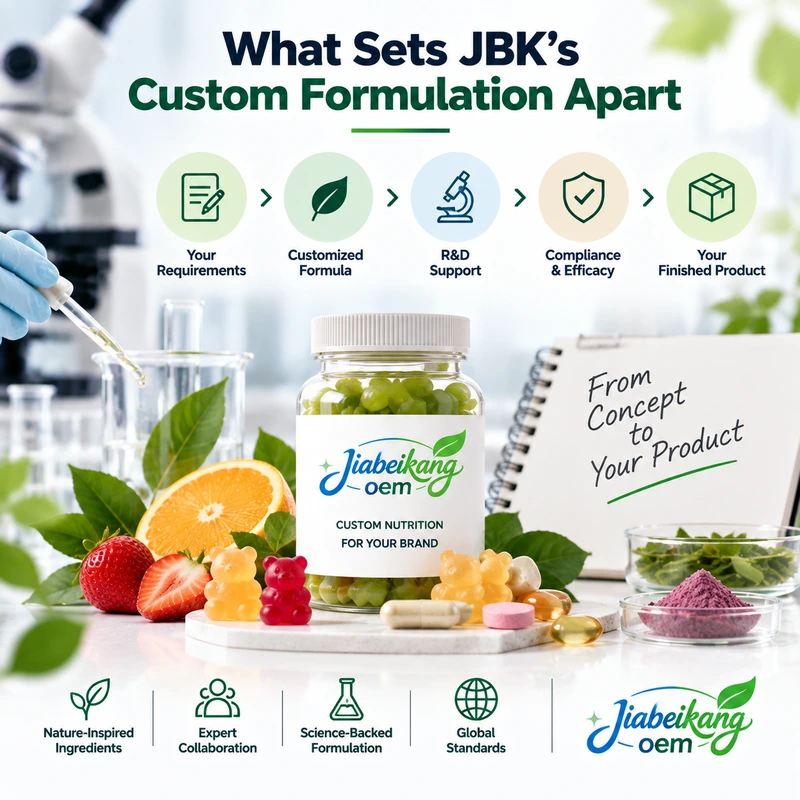
We’re not a formula catalog — we’re a full development partner working from concept through to finished product. Our formulation team builds each supplement around the specific brand’s requirements, validating efficacy and compliance as part of the process rather than after the fact. That’s the reverse order of how a stock formula works: instead of “build it, then sell it,” we start by understanding what the brand needs, then build backward from there.
Manufacturers running comparable custom programs describe the same underlying logic: the process starts with a formulation brief — target consumer, intended health outcome, dosage form preference, and competitive positioning — before the in-house team builds a formula around ingredients with real supporting data, rather than pulling from a fixed inventory. Our R&D team collaborates with domestic and international universities and industry experts, which is exactly why a custom formula, from the design stage onward, tracks closer to what a specific brand’s nutrition goals actually require.
Nutrient Precision & Dosage: The Core of This Nutrition Comparison
The real gap shows up in dosage precision. A stock formula, built to fit every customer, tends to land its active ingredient levels somewhere around an industry average — not low enough to undercut the claim, not high enough to inflate cost. It’s a compromise by design.
Custom formulation works differently. Brands work with our formulation team to set the exact milligram amount of each active ingredient, based on the target effect, the target consumer, and even regulatory ceilings in the intended market. That precision is what lets a product carry a specific, verifiable claim on the label — “500mg of X extract per serving” instead of a vague “contains X.” In any real nutrition comparison, this is usually the first thing a buyer or a knowledgeable consumer checks, and it’s the hardest gap for a stock formula to close.
Raw Material Quality & Supply Chain Control
Nutrition data starts with the raw material, not the formula sheet. Stock formulas, built for cost control and batch consistency, typically lock into a fixed set of suppliers, with raw material grade set at “good enough” rather than optimized.
We work only with trusted suppliers to make sure every raw material is pure, safe, and potent — that’s the first step in our production process, ahead of formulation and filling. In a custom project, brands can even help specify sourcing and purity standards alongside us, a level of control a stock formula model simply doesn’t offer — you’re buying into someone else’s already-locked-in material plan, with no room to negotiate or swap it out.
Nutritional Performance Across Dosage Forms
Our production lines cover gummies, softgels, capsules, tablets, powders, liquid oral solutions, and functional drinks, and this matters because the dosage form itself changes how a nutrient actually gets absorbed. Industry research consistently points to dosage form as a direct driver of consumer experience and absorption efficiency — powders offer flexibility in dosing and flavor systems, capsules deliver dosing precision and convenience, and tablets can carry more advanced release mechanisms like time-release or enteric coating.
Third-Party Testing & Quality Certification
Whether a nutrition claim holds up ultimately comes down to independent verification. We hold GMP, ISO 22000, ISO 9001, HACCP, FDA-registered, and HALAL certifications, and we verify raw material accuracy through lab analysis to confirm compliance with GMP, FDA, ISO, and HACCP standards. These certifications aren’t part of the formula itself, but they determine whether the numbers written into that formula can actually be trusted.
Stock formula manufacturers often hold similar certifications, but those usually cover process-level compliance — not necessarily formula-specific stability testing for every single stock blend. In our custom projects, stability testing is a fixed part of the R&D process, built to confirm how much of the active ingredient actually survives through the full shelf life. That’s what determines whether the number printed on the label still matches what’s in the product by the time it reaches the consumer.
Label Claims & Market Competitiveness
Nutrition precision only matters commercially once it becomes a claim you can legally print. Custom formulation supports a more specific nutrition story — exact dosages, targeted demographics, differentiated benefit combinations. Stock formulas, built for generic use, tend to stay at the category level — “supports general wellness” — because there’s rarely a specific enough number behind the claim to say more.
In a crowded market, that gap shows up directly in conversion. Consumers and distributors are increasingly comparing actual numbers on a supplement facts panel, not just adjectives on the front of pack. That’s why this nutrition comparison treats label claims as its own section — it’s where nutrition data finally turns into something a buyer can act on.
Cost Comparison: Is Custom Really More Expensive?
The cost gap is real, but it’s worth unpacking. Industry data shows stock formulas (capsules/tablets) typically run MOQs of 100–500 units at $0.20–$1.50 per unit, with startup investment under $5,000; custom formulations typically start at MOQs of 2,500–5,000 units, costing $5–$8 per unit, with startup investment in the $20,000–$75,000+ range. Our own MOQs shift depending on the specific product and packaging, and we work project-by-project on the exact numbers.
Short-term, custom formulation costs more — that’s not in dispute. But the longer-term calculation is about brand equity and differentiation. A stock formula’s low cost is built on the fact that anyone can buy the same thing, which leaves almost no pricing leverage once a competitor undercuts you. Custom formulation’s higher upfront cost buys formula ownership and a nutrition claim nobody else can replicate — an asset a stock formula simply can’t offer when a brand is raising capital or scaling.
Decision Checklist for Brand Owners
Before choosing between a stock formula and custom formulation with us, run through these questions:
- Is the goal to validate a market fast, or to build a long-term moat?
- Do you need a specific, verifiable nutrition number on your label — not just a general claim?
- Does your target market require certifications like HALAL, FDA, or HACCP as a hard requirement?
- Can your budget and MOQ absorb the longer development timeline custom formulation and stability testing require?
- If a competitor got access to the exact same formula tomorrow, would your product still hold its edge?
If the answers point toward differentiation and a long-term moat, custom formulation is the more sound path. If the goal is validating a category fast at minimal cost, a stock formula remains a reasonable starting point — neither option is universally better, it’s a question of what stage your brand is actually at.
FAQ
Industry norms put stock formula MOQs around 100–500 units, while custom formulations typically start around 2,500 units. Ours shift based on the specific product and packaging — reach out and we’ll work up a project-specific number.
Not exactly “higher value” — more precise and more verifiable. Custom formulation lets a brand set exact active ingredient dosages backed by stability testing; a stock formula is set at a generic level meant to work across many customers at once.
We hold GMP, ISO 22000, ISO 9001, HACCP, FDA-registered, and HALAL certifications. These cover process-level compliance and form the credibility baseline behind any nutrition claim — though formula-specific stability data still needs to be run separately for each product.
Conclusion
The core finding of this nutrition comparison is straightforward: a stock formula solves for speed; custom formulation solves for precision and exclusivity. As the dietary supplement market keeps expanding and formula sameness keeps intensifying, our custom R&D capability, multi-format production lines, and full certification stack help brands build a real gap in nutrition precision and label credibility over a stock-formula competitor. If you’re weighing which path fits your product line, reach out to our team for a plan built around your target consumer and budget.

