
Constantly feeling tired doesn’t necessarily mean you aren’t getting enough sleep; often, it indicates your body is lacking something specific. If you are looking into “energy vitamins” for women, the real questions to ask aren’t about which bottle looks best, but rather which ingredients actually work and which formulations make it easy enough to stick with the routine until you see results. Here is what we know so far.
“Energy” on a label doesn’t mean what you think it means
Walk into any supplement store and half the bottles on the shelf claim to boost energy. But that one word is doing a lot of work — it actually covers three pretty different approaches. Some formulas lean on stimulants, which is really just caffeine dressed up. Others are addressing an actual deficiency, the kind that shows up on a blood panel. A third group runs on adaptogens — herbs that don’t hand you energy directly, but help your body cope with the stress quietly draining it in the background.
The difference matters more than it sounds like it should. A caffeine buzz feels great for an hour, then leaves you flatter than before once it wears off. Nutrient-repletion formulas work slower, but they’re fixing the actual cause instead of papering over it. Knowing which bucket a product falls into is the real first step — toward something that helps your body, not just your mood for the next sixty minutes.
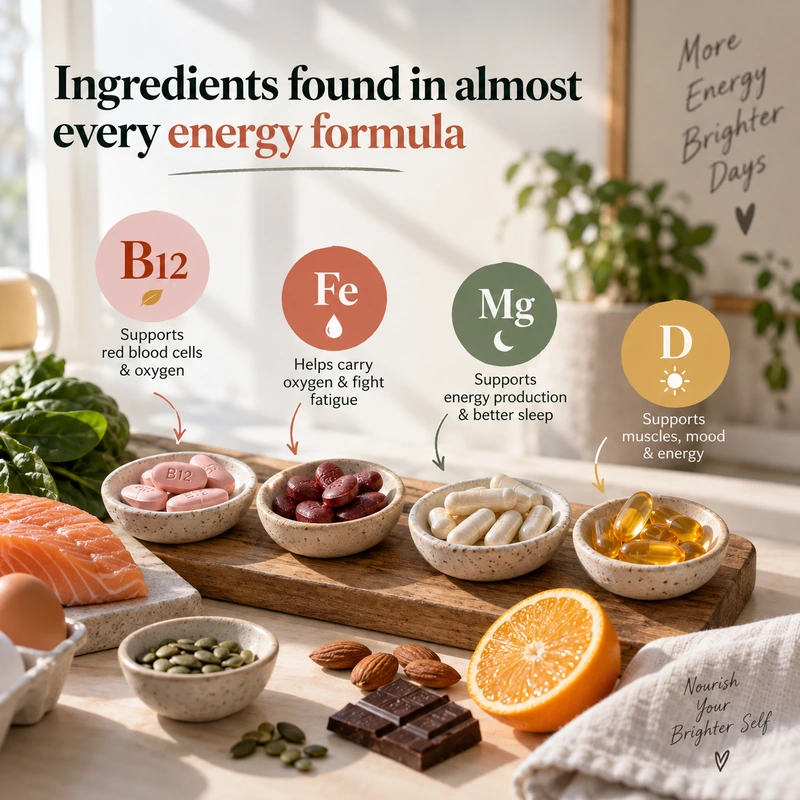
Ingredients found in almost every energy formula
Vitamin B12
B12’s main job is making red blood cells — the ones that haul oxygen through your body. When levels drop, that whole delivery system starts lagging, and that’s usually behind the fatigue, the brain fog, the heavy, worn-out feeling in your limbs.
The RDA sits around 2.4 mcg a day for most adult women. Deficiency is more common than people assume, though, partly because stomach acid naturally declines with age, so absorption gets tougher even if you’re eating the same as always. And since B12 is concentrated almost entirely in animal foods, vegetarians and vegans usually need to pay more attention here than they’d expect.
Iron
Probably the most overlooked cause of fatigue in women, and it tracks closely with blood loss during menstruation. Standards shift depending on where you look — UK guidelines put the daily requirement for women 18 to 50 at around 14.8 milligrams, while some US sources lean closer to 18. The exact number matters less than this: pairing iron with vitamin C makes a real, measurable difference in how much the body actually absorbs.
Magnesium
Magnesium’s role is converting food into energy your cells can actually use. When it’s low, you get that specific, almost unfair combination — dead tired, but somehow still awake when you lie down. Women need roughly 270 mg a day from food; for supplements, 200 to 400 mg of elemental magnesium is considered safe for most healthy adults. Magnesium glycinate absorbs better and sits easier on the stomach than the cheaper magnesium oxide.
Vitamin D
Nicknamed the sunshine vitamin for a reason. Low levels show up as muscle weakness, and a growing body of research ties it to mood and motivation too. Recommended intake sits at 400 to 800 IU depending on age and sun exposure, though a lot of doctors care more about blood levels — aiming for somewhere around 30 to 50 ng/mL. That brutal winter fatigue a lot of people feel is often this exact deficiency at work, since sunlight is the body’s main source.
Quick Guide to Key Ingredients
| Ingredient | Primary Function | Typical Daily Amount | Good Combinations | Consequences of Deficiency |
|---|---|---|---|---|
| Vitamin B12 | Red blood cell formation & oxygen transport | 2.4–2.6 mcg | Folic acid, B6 | Fatigue, brain fog, poor complexion |
| Iron | Oxygen transport via blood | 14.8–18 mg | Vitamin C | Fatigue (worse during heavy periods) |
| Magnesium | Supports cellular energy production | 200–400 mg (supplement) | Vitamin B6 | Poor sleep, muscle tightness, low energy |
| Vitamin D | Supports muscles and mood | 400–800 IU | K2, Magnesium | Weakness, low mood, winter fatigue |
This table is just a starting point, not a medical diagnosis. Actual needs vary based on diet, blood test results, and life stage; rather than guessing, it is better to get a blood test.
Adaptogens: Rhodiola, Maca, Ashwagandha
These work differently than the nutrients above. They’re not filling a specific gap — they’re helping the body hold up under the stress that’s quietly draining it in the background.
Ashwagandha has the most research behind it out of the three. Typical dosing runs 300 to 600 mg of a concentrated extract daily, and it takes a few weeks of consistent use before you actually feel anything. Don’t expect it to work the day you start.
Rhodiola gets marketed around “staying sharp under pressure,” which is why it shows up so often in formulas built for workplace burnout rather than plain physical fatigue.
Maca leans more toward hormonal balance. It’s a common addition to formulas targeting perimenopausal fatigue, usually paired with something for libido too.
Here’s the thing worth sitting with: nutrient supplements and adaptogens aren’t really doing the same job. One replenishes something the body is genuinely short on. The other supports a system that’s overloaded, even if nothing shows up as clinically “deficient.” Pair one from each category, and you end up covering a lot more real-world fatigue than either one could handle alone.
Choosing between capsules, gummies, and powders
Capsules remain the mainstay of this category for practical reasons: they can accommodate a complete blend of ingredients—such as B vitamins, iron, magnesium, and vitamin D—without needing sugar or flavorings to mask the taste. Production costs are also the lowest, making it easiest to achieve effective dosage levels.
Gummies sacrifice a bit of nutritional density for the sake of convenience. Iron is notoriously difficult to stabilize in gummies—often imparting a metallic, astringent taste—so most energy gummies omit iron entirely in favor of B vitamins or adaptogens. While gummies may be at a disadvantage regarding ingredient variety, they win on compliance: most people are more willing to chew a gummy daily than remember to swallow a capsule.
Powders are ideal for those who prefer mixing supplements into their morning coffee or smoothie. They allow for higher single doses and faster absorption, though the downsides include portability issues and the difficulty of precisely controlling the dosage.
Dosage Form Comparison
| Dosage form | Absorption rate | Relative cost | Shelf life | Suitable Scenarios |
| capsule | medium | lowest | longest | I would like the complete list of ingredients. |
| Gummy | medium | Relatively high | Shorter | Seeking convenience and wanting to build a habit |
| powder | quick | medium | relatively long | Take a high dose as part of your daily regimen. |
When checking the ingredient list, focus on these three areas
Specific milligram amounts. If a label simply states “B-Complex” without specifying the dosage for each individual vitamin, it is impossible to determine whether the amounts are actually meaningful.
“Proprietary Blend.” This labeling method groups several ingredients under a single total weight, making it impossible to know the exact quantity of each. It is a common cost-cutting tactic: the ingredient list looks impressive, but the amounts of key ingredients are quietly kept low.
Conflicting ingredients. Iron and calcium compete for absorption when taken together; if a product contains full doses of both in a single serving, it usually indicates that absorption wasn’t considered during formulation.
Selecting ingredients and formats based on life stages
No single combination suits everyone; the right choice depends on what the body is currently experiencing.
Women during menstruation: Formulas centered on iron, paired with vitamins C and B12, are ideal. Capsules are a reliable format, as it is difficult to formulate iron effectively into gummies.
Postpartum and breastfeeding: B12 and vitamin D needs tend to run higher during this stage. The safer bet is usually a gentler capsule — something that won’t double up on what’s already in a prenatal they might still be taking.
Perimenopause and menopause: Magnesium paired with B6 shows up a lot in formulas here, mostly for sleep support and helping with cortisol swings. Maca tends to get folded into these blends too, often built right into the formula rather than sold as its own product.
High-stress professionals: Formulas based on adaptogens—such as Rhodiola or Ashwagandha paired with B-vitamins—are more suitable, as the primary challenge is mental fatigue rather than physical exhaustion.
Fitness enthusiasts and athletes generally prefer capsules or powders containing a comprehensive B-complex and magnesium. These are often incorporated into pre- or post-workout supplement routines rather than taken as standalone daily vitamins.
Common formulation mistakes
A handful of issues keep showing up in weaker energy formulas, and they’re worth knowing whether you’re the one buying or the one building.
Stacking iron and calcium into a single dose quietly undercuts how much iron your body actually absorbs. Tossing in magnesium or an adaptogen at a token amount makes the label look impressive, but the body barely notices — both need a real, effective dose to do anything at all. Then there’s the cost-cutting move of using a cheaper, poorly absorbed form of an ingredient: magnesium oxide standing in for glycinate, or cyanocobalamin instead of methylcobalamin as the B12 source. It saves money, and it costs you the effectiveness that was the whole point.
One more thing that gets overlooked constantly: stability testing on iron gummies. Skip it, and you’re looking at one of the most common reasons a first production run gets bounced back for reformulation. Iron oxidizes fast, and without the right process behind it, the product can go off — taste, smell, both — before it even reaches a shelf.
Common Questions
B12, iron, magnesium, and vitamin D cover the most common causes of fatigue — the kind you can actually confirm with a blood test. Adaptogens like ashwagandha and rhodiola operate differently, working through the stress response rather than fixing a deficiency directly, which means they run on a different timeline entirely.
For B vitamins and adaptogens, barely any difference. Iron’s another story — capsules are the more reliable choice, since iron is hard to stabilize in gummy form and tends to bring taste and shelf-life problems with it.
Yes. The pairing that actually causes problems is iron and calcium, not iron and magnesium.
B12 and iron usually take a few weeks — the body needs time to rebuild what’s been depleted. Adaptogens follow a similar pattern. Sticking with it matters more than any single dose does.
At standard doses, mostly yes. If you’re on prescription medication, it’s worth checking for interactions first. And if you haven’t actually been diagnosed with low iron, talk to a doctor before supplementing long-term — the body isn’t great at getting rid of the extra.
A standard multivitamin spreads coverage thin, dosed for basic maintenance across the board. Energy-focused formulas zero in on the nutrients tied directly to fatigue, usually at higher amounts, and often throw in an adaptogen you wouldn’t find in a regular multivitamin at all.

